This is default featured slide 1 title

Go to Blogger edit html and find these sentences.Now replace these sentences with your own descriptions.This theme is Bloggerized by Lasantha Bandara - Premiumbloggertemplates.com.

This is default featured slide 2 title

Go to Blogger edit html and find these sentences.Now replace these sentences with your own descriptions.This theme is Bloggerized by Lasantha Bandara - Premiumbloggertemplates.com.

This is default featured slide 3 title

Go to Blogger edit html and find these sentences.Now replace these sentences with your own descriptions.This theme is Bloggerized by Lasantha Bandara - Premiumbloggertemplates.com.

This is default featured slide 4 title

Go to Blogger edit html and find these sentences.Now replace these sentences with your own descriptions.This theme is Bloggerized by Lasantha Bandara - Premiumbloggertemplates.com.

This is default featured slide 5 title

Go to Blogger edit html and find these sentences.Now replace these sentences with your own descriptions.This theme is Bloggerized by Lasantha Bandara - Premiumbloggertemplates.com.

Friday, 1 January 2016

Joan Crawford's Greatest Roles

Joan Crawford died May 10, 1977 – 35 years ago today. Though today she is remembered nearly as much for her off-screen dramatics as her work on the silver screen – Crawford was the Mommie Dearest of book and film fame, afterall – she enjoyed a film career that lasted nearly half a century and saw her appear in more than 80 films. Here are five of the infamous mom's most memorable roles.

The Unknown (1927)

Crawford began her career in the silent era in 1925 as a double for Norma Shearer in Lady of the Night. Her early credits are littered with roles like Ballroom Dancing Extra, Party Guest and the like, but in 1927 she starred in The Unknown opposite the biggest star in Hollywood – Lon Chaney, the famous "Man of 1,000 Faces." Directed by Tod Browning (Dracula, Freaks), she plays Nanon, daughter of a circus owner and love interest to Alonzo, the armless knife thrower played by Chaney. Chaney gives one of his best performances in this demented silent classic, and Crawford said she learned more from him in this film than all the other movies in her career put together. Citing the experience as a turning point, she said it was while working on The Unknown that she began to take acting seriously.
Grand Hotel (1931)

Boasting arguably the best cast of any film Crawford would appear in, Grand Hotel features Greta Garbo, John Barrymore, Lionel Barrymore and Wallace Beery. Based on the 1929 German novel Menschen im Hotel, the ensemble film interweaves the intrigues of patrons at Berlin's finest hotel. Crawford plays Flaemmchen, a stenographer and aspiring actress using her feminine wiles on industrialist General Director Preysing in hopes of advancing her career. Garbo, meanwhile, plays an aging Russian ballerina who falls for a Baron staying at the hotel. Though Garbo and Crawford do not appear in any scenes together, the two were fiercely competitive. Crawford was upset at not getting top billing, and as a revenge insisted on showing up late on set and playing Marlene Dietrich records – knowing Garbo loathed both. The film became the only movie to win the Academy Award for best picture without receiving any other nominations.
The Women (1939)

Crawford worked with a number of noted directors during her career, including William Castle, Howard Hawks, Robert Aldrich, Otto Preminger, Nicholas Ray and Jules Dassin (she also worked with Steven Spielberg in his TV directorial debut, an episode of Rod Serling’s Night Gallery). One of her most frequent collaborators was George Cukor, with whom she made four pictures. Perhaps the best of their work together was The Women, a comedy about the lives of wealthy Manhattan women played by Crawford, Norma Shearer, Rosalind Russell, Joan Fontaine, Hedda Hopper and a host of others. In fact, every person appearing in the film, right down to the 120 some extras, were women – even the pets onscreen were female. Cukor took on the project after being fired from Gone With the Wind, and although it won no awards, the movie was a critical and commercial success. In 2008 The Women was remade with Meg Ryan, Eva Mendes, Annette Bening, Jada Pinkett Smith, Bette Midler and Debra Messing. Mendes played the character originally portrayed by Crawford – Crystal Allen, a perfume counter girl having an affair with one of the other women's husbands. The remake was a commercial and critical flop.
Mildred Pierce (1945)

After The Women, Crawford appeared in a string of forgettable flops herself and ended up leaving MGM as a result. Mildred Pierce was her first starring role at Warner Brothers. Director Michael Curtiz originally wanted Bette Davis in the role, but Davis wasn't interested and the reluctant studio made Crawford undergo a screen test before casting her – surely a blow to the ego for a star of her stature (and it's well-documented that Crawford didn't lack in the ego department). Based on a novel by hardboiled crime writer James M. Cain, William Faulkner contributed to the screenplay about the struggles of a divorced single mother and her ungrateful daughter. Still considered a classic of its era, the film earned Crawford her only Academy Award and was nominated for best picture. It also did much to resurrect Crawford's career, ending her reputation as box office poison and winning her a slew of high profile starring roles.

Whatever Happened to Baby Jane (1962)

To say that Bette Davis and Joan Crawford didn't like each other is an understatement. Longtime rivals, they temporarily put their differences aside to star in the Robert Aldrich directed thriller about disabled, former big-time actress Blanche Hudson living in a decaying mansion and being tormented by her psychotic sister, a former child star known as 'Baby' Jane. Said director Aldrich of their pairing, "It's proper to say that they really detested each other, but they behaved absolutely perfectly." Well, not exactly. Davis, aware that Crawford was on the Pepsi-Cola Board of Directors (her late husband had been Pepsi's CEO), insisted on having a Coca-Cola machine installed in her dressing room. While filming a fight scene, Davis kicked Crawford in the head. Crawford retaliated by concealing weights under her gown during a scene where Davis had to carry her up the stairs, causing the latter actress to strain her back. When Davis was nominated for an Academy Award for the role, Crawford reputedly campaigned against her, even going so far as to contact Anne Bancroft and offer to accept the best actress award in her honor should she be unable to attend the Oscar ceremony. In the end, Crawford did just that, inciting a feud that would see the two actresses publicly exchanging barbs for the rest of their lives.

Hoping to repeat Baby Jane's successful formula, Aldrich again cast the pair in Hush…Hush, Sweet Charlotte, but Crawford dropped out after a campaign of intimidation by Davis and was hospitalized. Crawford ended up detesting Aldrich as well. "He is a man who loves evil, horrendous, vile things," she said. For his part, Aldrich said he remained fond of Crawford. Her last movie role came in the 1970 sci-fi horror film Trog, seven years before her death May 10, 1977.

Joan Crawford American actress

Joan Crawford, original name Lucille Fay LeSueur (born March 23, 1908, San Antonio, Texas, U.S.—died May 10, 1977, New York, N.Y.), American motion-picture actress who made her initial impact as a vivacious Jazz Age flapper but later matured into a star of psychological melodramas. She developed a glamorous screen image, appearing often as a sumptuously gowned, fur-draped, successful career woman.


Crawford danced in nightclubs under the name Billie Cassin, and by 1924 she was dancing in Broadway musicals. On the screen from 1925, she danced her way through such popular films as Our Dancing Daughters (1928), Dance, Fools, Dance (1931), and Dancing Lady (1933). Among her early successes as a dramatic actress were The Women (1939), Susan and God (1940), Strange Cargo (1940), and A Woman’s Face (1941).


A major turning point in Crawford’s career was her performance in Mildred Pierce (1945), for which she won an Academy Award. The story of an emotional and ambitious woman who rises from waitress to owner of a restaurant chain, it was followed by such high-quality pictures as Humoresque (1947), Sudden Fear (1952), and The Story of Esther Costello (1957). Later successful roles were in What Ever Happened to Baby Jane? (1962) and The Caretakers (1963).


Crawford was married to the actors Douglas Fairbanks, Jr. (1929–33), Franchot Tone (1935–39), and Phillip Terry (1942–46) and to Alfred Steele, the chairman of the Pepsi-Cola Company. After his death in 1959 she became a director of the company and in that role hired her friend Dorothy Arzner to film several Pepsi commercials. Crawford’s adopted daughter Christina published Mommie Dearest (1978), an account of the harsh childhood that Christina and an adopted brother had at their mother’s hands, and a film version was produced in 1981.

Joan Crawford Biography

Joan Crawford was an Oscar-winning actress, dancer and executive. She was known for films like Whatever Happened to Baby Jane? and Mildred Pierce.

Synopsis

Born on March 23, 1905, in San Antonio, Texas, Joan Crawford began dancing at a young age, and went on to act in dozens of films. She was one of Hollywood's top stars of the 1930s, earning an Oscar for her lead role in 1945's Mildred Pierce. She later became known for the horror classic Whatever Happened to Baby Jane? and was the subject of the memoir Mommie Dearest. She died on May 10, 1977, in New York City.


Early Life

Film actress Joan Crawford was born Lucille Fay LeSueur in San Antonio, Texas, on March 23, 1905 (though some sources have reported her birth date as 1908). Her parents separated before she was born, and her mother later married theater owner Harry Cassin. Crawford would come to be known as Billie Cassin growing up, and periodically throughout of her entertainment career.

After her mother and stepfather split, Crawford attended two private schools, where she worked on the premises to pay for tuition while also being treated harshly, receiving corporal punishment for perceived misdeeds. Because of her workload, she was unable to attend classes and her scholastic record was faked.

Big Break in 'Our Dancing Daughters'

After a short time at Stephens College, Crawford left to pursue a dancing career, a pastime to which she'd dedicated herself. She eventually danced in the Broadway show Innocent Eyes, and in 1925 started to work onscreen for MGM. She starred in a number of silent films during this period and was given the name "Joan Crawford" from a magazine contest sponsored by the studio. The actress hit it big with the smash Our Dancing Daughters (1928), in which she played a rich, lovelorn girl who moves to Charleston.

A prolific and long-lasting film career was to follow, with Crawford ultimately going on to star in more than five dozen films. She took on talking roles with projects like Hollywood Revue (1929) and Grand Hotel (1932), and her dancing skills were prominently displayed with Fred Astaire in the 1933 hit Dancing Lady. Clark Gable was also featured, and was a recurring co-star in works like Possessed (1931) and Strange Cargo (1940).

Oscar for 'Mildred Pierce'

Crawford was a major, top-earning star of the 1930s, though by the end of the decade, her pictures were meeting with limited success. She rallied again with A Woman's Face (1941) before leaving MGM and signing with Warner Brothers, eventually garnering the lead role in 1945's Mildred Pierce, about a mother who rises from humble beginnings to become a successful restaurateur. The film received several Academy Award nominations, and Crawford won for best actress.

Crawford would receive two more Oscar nominations over the years, one for her role as a schizophrenic nurse in another film by the name Possessed (1947), and the other as a playwright in the thriller Sudden Fear (1952), which she'd also produced. She became known for a steadfast devotion to her career and a willingness to adapt to different vehicles while cultivating a fan base.

Comeback in 'Whatever Happened to Baby Jane?'

Though garnering a series of notable roles, by the late 1950s, Crawford's career had grown quiet, only to be revitalized yet again with the 1962 horror classic Whatever Happened to Baby Jane?, co-starring with Bette Davis. Crawford subsequently starred in several other thrillers and did television work. She also penned the 1971 memoir My Way of Life.

Joan Crawford died of a heart attack on May 10, 1977, in New York City, leaving a multifaceted film legacy that would inspire analysis for years to come.

Family Life and Abuse

Crawford was married four times, with three marriages to actors, one of whom was Douglas Fairbanks Jr. In 1956, she wed Alfred Steele, chairman of Pepsi-Cola. After his death in 1959, Crawford joined Pepsi's board of directors—becoming the first woman to do so—and went on to work as a spokesperson on behalf of the company.

Crawford adopted four children, one of whom, Christina, wrote the 1978 memoir Mommie Dearest, in which she writes of enduring highly erratic and abusive behavior from her mother during childhood. The book was adapted into a 1981 film starring Faye Dunaway as Crawford.

The Revolt of Joan Crawford's Daughter

In June, 1939, less than two months after her divorce from actor Franchot Tone, Joan Crawford adopted a baby girl. She named her Christina.

Three years later the actress brought another child, Christopher, into her household. Still later, following the breakup of her marriage to actor Philip Terry, she adopted twin girls, Cathy and Cynthia.

"I've always loved children and wanted children," Joan Crawford explains. "I would like to have had eight."

Toward Christina, however, on whom she once lavished much love, the actress today expresses very different feelings. "It has been eighteen years of disappointment,"she says of her relationship with her oldest child.

Hurt and bewildered, Christina, now herself a struggling young actress, has tried to trace the steps that have estranged her from a once apparently devoted and loving mother. Where did their relationship go wrong? Why do two women now face each other across a chasm of misunderstanding when at one time there was the closeness of a tender mother and an adoring child?

These questions are not easily answered. For the conflict between Joan Crawford and Christina has reached such intensity that when interviewed, mother and daughter often give completely contradictory versions of the same events.

Christina's earliest memories hardly foreshadow the trouble that was to come. Nor are they the typical memories of an overindulged but neglected Hollywood child.

"Mummy was with me constantly," Christina says. "No matter where she went, even when she travelled across the country, I went along too."

There were governesses, of course, but Christina has no feelings of having been abandoned to them when was little. Whenever Joan Crawford was working on a movie, the actress would rush home each evening to sit with Christina at dinner, to hear her prayers and to tuck her into bed.

"And she read poetry to me in that marvelous voice of hers," Christina says. "She read the poems of Edna St. Vincent Millay and the sonnets of Shakespeare. When I learned to read we took turns reciting stanzas. Mother loved poetry and she wanted me to be exposed to it as early as possible.

"When she thought I was old enough to understand, she told me that I had been adopted. She said I was picked out specially and delivered on a pink cloud. It sounds awfully sticky now, but sounded beautiful to me then. Mother knew that the neighborhood kids would find out and tease me and she wanted me to learn the truth in the best possible way."

One of Christina's earliest memories is the arrival of her adopted brother Christopher. "I was only three and a half at the time, but I remember it well. He was like a little angel with a sweet, round face, and blond hair that was just beginning to come in."

Christina and Christopher were not shunted off to the nursery, as so often happens with children of the wealthy and famous. They were allowed to be on hand when company came, and Christina remembers many of the famous people who came to the big Brentwood house. The late Louis B. Mayer, who held Joan Crawford's contract, was a constant visitor. Judy Garland often appeared at parties, and Christina would follow her around enthralled. "She had the voice of an angel, and was the most beautiful person I had ever seen."

The late John Garfield made an indelible impression on the girl when he came to the house one night for a screening of Humoresque, in which he co-starred with Joan Crawford. After the screening, which Christina was allowed to attend, he carried her to her room. "I thought he was the most marvelous creature in the world, " she said, "and I decided that if I ever married, it would have to be someone like him."

As Christina grew older she began to see less and less of her mother. "Not that Mother didn't try to give us time. The problem was just she didn't have that much. You can't build a career like she built and have a great deal of time left over for yourself or anyone else."

Yet Joan Crawford tried to make the most of her time with the children. "And, on the whole," she says, "I gave them more time that most normal mothers outside the movie business."

"We have wonderful memories of holidays and special occasions," Christina says. "Sometimes, too, Mummy used to drive Chris and me to a place called Mandeville Canyon, just ten minutes from the house, and we'd take a picnic lunch big enough for an army. When Mummy was working she'd always manage to meet us for soads or lunch downtown. And when she was terribly busy at the studio she'd take me along onto the set, just so I could be near her."

The most meaningful moments that mother and daughter spent together occurred when Joan Crawford took the children on trips up the California coast to the seashore resort of Carmel. "Mummy and I would take long walks along the sea wall," said Christina. "We talked a lot and I wish I'd been older because I know that she was telling me important things. But they escaped me because I was too young. I did understand her love for the ocean, through, and today I get an almost religious feeling from the sea."

If Christina's memories of her early childhood provide no clues of what was to follow, her mother's are more revealing.

Joan Crawford remembers that when Christina was very young, mother and daughter were "racing" through the water of the 65-foot swimming pool of the Brentwood estate.

"I let her win eight times," the actress says, "and then on the ninth time I struck out just a little bit and I won. She took a look at me and she swam back over to the steps and climbed out of the pool. She stood there and said, 'I'll never play with you as long as I live, never.' I said, 'Christina, look, my body is longer than yours. I could have won all the time. I'm bigger than you are. I'm faster than you are. I can win all the time. Now let's get back in the pool and play.' I picked her up to throw her into the pool and jumped in with her and made her swim."

In this recollection we have a glimpse, perhaps, of the kind of terms Joan Crawford was to offer Christina again and again as the child grew older. Christina could have luxury and love, she could have attention and even that most precious of all commodities, her mother's time. But in return she must know who was in control. She must know that her mother could win all the time.

There are children who can accept such conditions. They will trade obedience for attention, conformity for praise, independece for love. Christina, as her mother suggests, was not such a child. Perhaps already some of her mother's single-minded will to win had rubbed off on her.

By the time Christina was nine she and her mother were quarreling with increasing frequency. To some extent these were the normal quarrels of a mother and a pre-teen daughter over obedience and neatness, respectfulness and punctuality, the length of a skirt or the cut of a dress. They were probably exaggerated, however, by the fact that Joan Crawford was having trouble with her studio and in her personal life. They reached more than average intensity, too, because the actress held the same rigorously high standards for her children that she had always demanded of herself. There was constant bickering also because to Joan Crawford, whose own childhood had contained few of the amenities of life, it seemed excessively important that her children learn to please and to thank-you, to speak only when spoken to, to curtsy and to bow.

Like most nine-year-olds, Christina had begun asserting herself. She concedes that she was probably not too pleasant a child. She had strong opinions of her own which frequently clashed with her mother's equally decided views. "Whenever I tried to follow one of my ideas or express my own opinions," Christina says, "I was told that I was wrong. I would be contradicted so crushingly that I'd turn red as a beet. I was just supposed to do as I was told and keep quiet."

When Christina was ten Joan Crawford sent her away to boarding school because, the actress says, the local public school was failing to educate Christina in proper manners and deportment. The actress chose the coeducational Chadwick School, located south of Los Angeles in Rolling Hills, which was attended by the children of many other screen celebrities.

Christina liked Chadwick from the start. For the first time she knew the security of living by an ordered set of rules and regulations that emanated from a serene schedule rather than from the unpredictable, strenuous demands of a movie star's life.

Apparently Joan Crawford also was satisfied with the school, for the following September she arranged for Christopher to study there. Four years later Cathy and Cynthia, the twin girls whom the star adopted in 1946, also enrolled at Chadwick, at the age of eight.

Although Chadwick meant a new and in some ways happier life for Christina, her arguments with her mother started all over again during weekends at home and vacations. Christina remember these arguments as revolving mainly around the question of clothes, and if her memories are correct, they suggest that Joan Crawford was reluctant to see her daughter grow up.

"I was the youngest in my class," Christina recalls, "but I stood a head taller than everybody else and I was more physically developed than most of the girls. But I was the only girl who still had to wear what I felt were babyish dresses, little gingham things fastened in the back and far too short compared with what the other girls wore. Mother thought the other girls had horrible taste and she may have been right. But that didn't matter to me. All I knew was that I stood out like a peculiar odd-ball in my clothes."

At home, too, clothes were a constant source of contention between the actress, who was known for her impeccable taste in clothes, and her daughter, who merely wanted to be like everyone else. "One time when I came home for a visit and we were going somewhere, Mother wanted me to put on a black velvet dress which was cut in a little girl's fashion and which I detested with all my might. I begged her not to make me wear it, but she insisted. I felt so awkward and ugly and miserable in it that it completely took the tongue out of my mouth. If someone had asked me my name, I couldn't have answered.

"The trouble over clothes went on for a long time. Finally I began saving my allowance so that I could buy my own dresses. They were inexpensive, but at least they weren't different from what the other girls wore. Mother never knew about this. I would keep the dresses at school with me for the year, and before I went home for vacation I would give them away."

For the first two years of what proved to be a five-year stay at Chadwick, Christina visited home every other weekend. But as arguments between her and her mother grew more intense, the intervals between visits grew longer.

"When Christopher and I came home for summer vacation in June of 1953," Christina recalls, "things were downright miserable. There were constant battles with Mummy. I was home for less than two weeks before she sent me back to school again. A couple of weeks later my brother joined me there."

Joan Crawford also remembers that summer well, "It was a miserable time," she says. "Christina teased her young brother unmercifully and they both began picking on the twins. All four children had strong personalities of their own, and I felt that the best solution was to send Christina back to school."

Since 14-year old Christina and 11-year old Christopher were the only children at the school, they moved out of the dormitories and into the home of the couple who directed the institution, Commander Joseph Chadwick and his wife Margaret. The Crawford children had been told by their mother that she could no longer give them an allowance, so the Chadwicks proposed an alternative.

"They allowed me to work in their home," said Christina, "helping Mrs. Chadwick with the cooking, cleaning, general housework -- anything that had to be done. They paid me $30 a month, which I shared with Christopher. We kept the arrangement through that year and until I was taken out of school."

Although Christina was not aware of it, her mother had planned this financial setup herself. "I believed that it was excellent training for Christina to earn money by doing housework," says the actress. "The money she received was really paid by me. I told the Chadwicks to give it to her."

Christina enjoyed doing the work and living in the Chadwick's home. "I loved the Chadwicks," she says. "They were like my first real parents. Philip Terry, who was married to Mother briefly when I was very young, had never seemed like a father to me, and actually I have only vague recollections of him. Living with the Chadwicks was my first taste of normal family life."

Christina was supposed to spend Thanksgiving with her mother. She had been told to have a Christmas card list prepared when she came home. A few days before Thanksgiving, however, she told her mother over the telephone that the list was not ready.

"Mother became very angry and told me I couldn't come home. I snapped back, ' Then I don't want to. I'd rather stay here. ' In that case, Mother insisted, I had to come home. It was one of those hopeless 'Yes, you will,' 'No, I won't' arguments, and finally we hung up and she said to call back later that evening.

"That night the Chadwicks and I spent about three hours on the phone with Mother. The Chadwicks suggested that since things seemed to be in such a turmoil at home, it might be a good idea if I did spend Thanksgiving with them. Mother was very angry with them for taking my side. By that time it was just pure temper and pure anger. Nobody knew what anybody else was talking about.

"Finally, I just gave up. I said, 'All right, I'll come home Mother'

" 'Bring your things,' Mother told me. 'You're leaving school.'

"It was about eleven o'clock by then," Christina said, "I and I was on the verge of hysterics. I saw my whole life being taken away from me. This has been the only home I remembered where I had been happy and productive and felt as if I were part of something, without being told ten million things at one time and now knowing which to do first.

"And I was just getting somewhere at school. I was on the swimming team. I was one of three cheerleaders for the football team. I was holding responsible positions in my class and in school. For me this was a wonderful, wonderful time, and now it was going to end."

Christina didn't go home for Thanksgiving after all. But three days later her mother sent the station wagon for her.

"In it were three people -- the chauffeur, Mother's secretary and a man I had never seen before who introduced himself to the Chadwicks as a private detective.

"There were no scenes. I said goodbye to the Commander and Mrs. Chadwick and left for home -- at least, that's where I thought I was going.

"We hadn't driven ten minutes before I knew were weren't on the road to Brenwtood. Here I was with all my belongings, with these people I didn't want to talk to, being driven I didn't know where!"

Later that afternoon, the car reached the crest of a hill outside Pasadena, and Christina realized that she was being taken to convent, the Flintridge Sacred Heart Academy.

Joan Crawford's recollection of the event is completely at odds with that of her daughter. "The whole story," she says, "is a product of the girl's imagination. My relationship with the Chadwicks was always warm and friendly. Christina's behavior at school was not always what it should have been. She often dated and went away for weekends without my permission or that of the Chadwicks. I don't enjoy telling you this, but the real reason Christina left Chadwick was that she had been expelled -- and I will not say why. I sent her to the convent because it was the only school that would accept her."

(The Chadwicks do not wish to discuss the matter. In answer to a request for an interview they wired the following message: "From experience with Christina's mother, we consider it unwise to involve Chadwick by making any public comment. Very sorry." The telegram was signed, "Margaret Lee Chadwick.")

Christina Crawford's high-school transcript makes no mention of expulsion from Chadwick, and her scholastic standing is far above average. The only certainty that emerges from the conflicting claims of mother and daughter about this incident is that it left each more stubbornly unwilling to sympathise or communicate with or understand the other.

Shortly after Christina left Chadwick her mother also removed Christopher and the twins from the school, sending the boy to military school and the girls to Marymount Academy.

The Dominican sisters recall Christina as being at the time of her arrival at Flintridge, a sullen, frightened and bewildered girl. "All we were told before she came, "said a nun who had been on the convent staff, "was that there had been some 'difficulty' in her previous school."

During the first three days Christina wept constantly. "I didn't believe I could trust anyone. There was no mail, no phone calls, no visitors. I felt as though I were in prison."

When she could bear it no longer she went to the nun who was then principal of the school, Sister Mary Benigma, O.P., who listened sympathetically as Christina poured out her troubles. Together with the other nuns, Sister Benigna set about trying to win Christina's confidence.

"We asked the other girls to be especially kind," explained one sister, "since Christina was going through a very trying period. Gradually she began to understand that we were all her friends and that she was not in a place of punishment."

It took months, however, before Christina learned what she now feels to be the crucial lesson that the sisters had to teach -- that of acceptance. It was a difficult lesson for the high-spirited 15-year-old girl with a mind of her own, but she had time to meditate and with the assistance of the nuns to think constructively about herself, if not more kindly about her mother.

"We tried to teach her a concept of God and religion which would help her balance her problems," said one of the Dominican sisters. "We tried to imbue her with a sense of the acceptance of the will of God. And when we realized the caliber of the person we were dealing with, we came to respect and love her very much. She is a highly principled, intelligent young lady who was able to cope with situations that would have underminded a girl with less courage and spirit."

Six months after Christina was placed in the convent, her mother phoned her to say she had married again. The movie star's fourth husband was Alfred Nu Steele, a business executive. Although they had known each other for four years they wed on impulse, flying to Las Vegas for a 2 a.m. ceremony in the penthouse of the Flamingo Hotel.

The date was May 10, 1955, and the Steeles spent the summer honeymooning in Europe. Christina, for the third year in a row, remained in school while all the other students were off on vacation.

"The convent was very lonely," said Christina. "We were isolated on a high hill and there was almost nothing for me to do. For a few hours a day the nuns permitted me to work in the office and answer the telephone. But calls rarely came and when the phone did ring it actually started me. There was silence everywhere. When the sisters were on retreat the only sound I heard was the clocking of the rosary beads."

The first reunion of the Crawford children since their separation on leaving the Chadwick School took place on Thanksgiving, 1955. This was Christina's introduction to Alfred Steele, the man she now speaks of as "my father."

"The meeting was strange," she recalls, "and awkward. Yet I had the immediate feeling that he was tremendously kind. I have never felt such warmth, strength and understanding in any person. He was my idea of what a father should be."

Alfred Steele fulfilled Christina's first impression. "All four of us," she says, "Christopher, myself and the twins, loved him very much. And I believe he had real feeling for all of us."

From the bookshelf in her apartment she took down a pair of heavy silver cigarette lighters. "Daddy used them on hunting and fishing trips, and he gave them to me when I first moved into my own apartment. I use them as bookends, and they are my dearest treasure."

Soon after the Thanksgiving reunion, the entire family left for a three-month trip in Europe, through France, Switzerland and Italy. For Christina, reveling in the unexpected good fortune that had at last given her a father, this trip was a glorious experience. But Joan Crawford recalls it as a "miserable time." Christina, she felt, intruded on her privacy with her new husband and allowed them no time together. Mr. Steele too, the actress says, was not enchanted by the continual presence of a 16-year-old girl.

After the trip Christina returned to finish her senior year at school. It was not long, however, before she was again in trouble with her mother. She had been forbidden to see the Chadwicks, but she went for a visit anyway, "somewhat sneakily," she admits. Somehow Joan Crawford discovered this, and she promptly fired off "two absolutely scathing letters in which she forbade me to ever see the Chadwicks again."

Greatly distressed, Christina spoke to one of the sisters and told her what had happened. "She let me talk," the girl said, "and she pointed out that what I had done was wrong. But she also had spoken to the Chadwicks many times, and she knew how devoted I was to them, so she could understand at least a little bit. She explained that I would simply have to try to realize that Mother didn't have the backrgound to accept some things -- that she had been robbed of her own childhood and had had to fight very hard for everything she had ever gotten, and that as a result she wanted things done her way and not any other."

The incident occurred in February, 1956. Four months later, when it came time for Christina to graduate, Joan Crawford apparently still had not forgiven her daughter's disobedience. Although Christina had the second-highest average in her class and had been elected vice-president of the student body -- the highest honor a non-Catholic girl could achieve -- no member of her family was present to applaud her.

"She wanted to be on her own, so I let her," Joan Crawford says firmly.

"I was the only person in my entire graduating class with no relative at the graduation," Christina recalls, "and there were girls who came from as far away as Central and South America. I was the only girl forbidden to go to the party for the graduates, their dates and their parents, a completely chaperones affair -- I stayed in school that night. And then Mother wrote and said that for my graduation prsent I was to have been given a trip to London, where would be making the movie The Story of Esther Costello, but that now I would not be going. I stayed in school all summer."

In September, as she prepared to leave the convent, Christina Crawford realized how much she had learned during her two-year stay at Flintridge. The sisters had helped her come to terms with herself as a human being, and they had given her a religious feeling about life. Though she did not convert to Catholicism -- she belongs to no organized religion -- Christina left Flintridge with an unshakable belief in God.

Her ambitions had crystallized too, and she dedicated herself to becoming an actress. Christina's first acting experience had come when she was 11 and had starred in a production of H.M.S. Pinafore at Chadwick. But the acting bug had undoubtedly bitten her much earlier.

Joan Crawford has been as much involved in her daughter's dream as Christina would allow her to be, but it is hardly surprising that in this area, particularly, Joan Crawford's faith in her own way and Christina's equally strong-willed confidence in her have widened the rift between them.

Christina remembers one conversation that occurred when she was 13, as they left a set where she had watched her mother performing.

"If you ever decide to make this your life," the actress said, "I want you to know it won't be easy. But I do want you to do it well. It has to be your own choice, though. I'll never push you into it."

Joan Crawford did not push. She did Christina some coaching and worked with her to improve her enunciation; but the constant heated differences of opinion about ways and means have made cooperation on Christina's career difficult, if not impossible.

Joan Crawford wanted Christina to study drama at Northwestern University. Christina chose Carnegie Tech instead. "My life," she said, "my life, for myself, did not begin until I reached college. I loved it there." Even so Christina quit Carnegie Tech after one year, against the advice of her mother, who considered it important for her to finish her schooling. Christina found herself bursting with impatience to be out of the classroom and actively engaged in the theater. For five years -- at Chadwick and at Flintridge -- she had been constrained, and now she could no longer contain her hunger for freedom, for involvement with the outside world.

Although Joan Crawford believed her daughter was making a mistake in failing to complete her education, she gave Christina her approval to work in summer stock at the Westport Country Playhouse, in Connecticut, where as an apprentice she did everything from moving scenery to scrubbing floors. During the fall and winter she studied under coach Sanford Meisner and then director Frank Corsaro.

Early in 1958, Joan Crawford obtained a job for Christina at the Music Corporation of America (M.C.A.), a mammoth agency that manages the financial affairs of actors, writers and musicians. Christina was hired as a receptionist.

Her mother saw this as a stepping stone on the path into the theater.

"I told Christina," she explained," 'Look, you'll know which scripts are going into which office and you'll know who is going to act in which play, so when you know there's a good play, so when you know there's a good part in one for you, get it -- read it. Take it home or read it on your lunch hour or in the ladies' room. It doesn't matter how, just get it and read it!"

Christina's own method of pursuing her career was somewhat different. "Everyone kept telling me to get a role in a play on my own," she said, "so when I heard that there was a part open in an off-Broadway play, I went down and applied, just as hundreds of other kids did. I wasn't convinced that it was too good a play, but I wanted the experience and was glad to get the part."

The New York reviewers roasted the production but gave Christina favorable notices. One critic expressed the mood of most when he wrote: "Young Miss Crawford found herself trapped in an off-Broadway production which was away off..."

Somewhat naively, perhaps, Christina believed that she had got the part solely on the basis of her own talents. The producers of the play, however, were not above plastering posters around New York listing Christina prominently as "Joan Crawford's daughter." Christina had the posters removed.

"But by then the damage was already done," she recalls. "Mother concluded that I was deliberately exploiting her name. She was away with Father at the time, so I didn't know then how furious this made her. She never mentioned the incident to me, and I only learned that it angered her very much when she discussed the matter with a newspaper columnist."

Joan Crawford did suggest to Christina that she change her name, a suggestion her daughter declined. "It's the only name," she said, "that I have ever had."

Shortly after the play closed, Christina quit her job. She wanted to devote all her time to seeking roles in the theater or on television. When her mother learned this, she was, as she puts it, "annoyed."

"After all," said Joan Crawford, "I found her a position where she was able to meet the biggest producers and directors in the industry."

Whether holding down a job in the theatrical agency or looking for one in the theater is the better steppingstone to stardom is a debatable but probably unimportant question. What is significant is that even now Joan Crawford was incapable of giving help to her daughter except on her own terms and Christina was incapable of accepting help from her mother exept on her own terms.

Several weeks after quitting M.C.A., Christina received a telephone call from her mother summoning her to the actress' luxurious New York apartment overlooking Central Park. She arrived to face an ultimatum. "If she felt she couldn't keep the job at M.C.A.," Joan Crawford says, "then I didn't feel I could help her any longer."

This inflexible stand stunned the equally inflexible Christina. "Mother had been giving me an allowance up until then," she explained, "and I really felt she'd approve of my decision and keep on helping me in the same way while I looked for work. Instead, she asked how much money I had, and when I told her I had about enough to live on for a month, she said that she was sorry but she didn't have any more money to give me and I'd better find another job."

They parted with bitterness.

It was a hard winter for Christina Crawford. She lived in a cold-water flat in a run-down section of Manhattan. She worked evenings as a cashier in a restaurant owned by the father of a friend. Each day she made the theatrical rounds, a treadmill of seeming futility. But she refused to quit. Her voice was used for a few television commercials, and by living frugally she succeeded in putting aside enough money for a trip to England, where she planned to live with friends and look for work in the theater. A few weeks after arrival she rushed home again. Alfred Steele had died suddenly.

"I was stopped cold," Christina said quietly. "I had never really had a chance to talk to him. But I believed somehow that he understood me far better than most people, and when he was gone I felt more terribly alone than ever before in my life."

Today, as she makes steady progress in her career, Christina still feels herself to be alone. Yet there are some signs that the disappointment and the bitterness that have characterized her relations with her mother may eventually come to and end -- or at least be softened with the years.

The real test of a mother, and her essential satisfaction, lies in her ability as her children grow older to become gradually and gracefully less necessary to then. This is a difficult challenge for most mothers. For Joan Crawford it has been an almost impossible one. For the very qualities which have made her a great and successful actress are the qualities least suited to being a successful mother. The ability to lose one's children instead of winning over them, to relinquish the stage to them instead of holding it, does not come easily to someone who has had to fight her way to the top through a magnificent confidence in her own talents and abilities.

Yet now that Christina is, in fact, independent and Joan Crawford, however reluctantly, has recognized this, there are signs that mother and daughter may come closer to understanding each other.

Last year Christina had her first movie part, in a film called Force of Impulse, which has yet to be released. The experience proved to have an unexpected emotional impact on Christina, one which has not fully run its course. It struck Christina the first day she visited the set to be fitted for her costume.

"It was spooky," she says with a quick smile. "For the first time in years I felt that I'd come home. And when I walked onto the sound stage it seemed as though Mother's hand was on me, guiding me. I remembered how it had been when I was young and she took me with her on the set, and suddenly I could remember almost every single thing she had ever told me about acting.

"Each day I found that I walked onto the set I found myself saying good morning and greeting people by name, until they got to calling me Miss Sunshine. That was always Mother's way, stepping onto a set and saying, 'Good morning, ladies and gentlemen.'

"My part wasn't very large, and yet after each day I found myself to exhausted to eat. It was much easier after that to understand what it must have been like for Mother all those years ago."

When Christina returned to New York, she wrote her mother of the experience and the feeling of closeness it had given her. Her mother replied by expressing pleasure at Christina's letter. "I'm sure the picture will turn out very well for you," she concluded. "I hope it will be the beginning of many, many more."

Today Joan Crawford can say, almost wistfully, "I would love to work with Christina now -- it would be great fun to help her, although she doesn't want it that way." Perhaps tomorrow she may want to help Christina, not because her daughter is doing what she would like her do in the way that she would like her to do it, but simply because she is her child.

And perhaps Christina, for all her lessons she has absorbed from her mother in the single-minded, self-reliant qualities that can help her become an actress, may still want to meet her mother halfway, simply as the admiring daughter of years ago. She may refuse to accept her mother as the arbiter of her life and the director of her career, but with a compassion born of her own struggle to become an actress she may understand Joan Crawford better and accept her as a source of inspiration and strength.

I'll never forgive Mommie

In 1978 Christina Crawford shocked the world with the first tell-all celebrity memoir, in which she exposed her Hollywood filmstar mother Joan as a cruel, abusive alcoholic. Thirty years on, and about to reissue her explosive book with new material, she gives her first interview in a decade. But why this compulsion to return to her painful past - especially when so many people don't believe her?

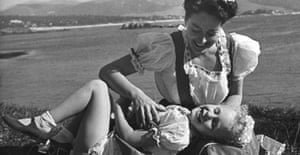
Actress Joan Crawford and her daughter, Christina, playing together in April 1945. Photograph: Time & Life Pictures/Getty Image Peter Stackpole/Getty
Christina Crawford was 13 when she stopped believing her mother loved her. It was a young age at which to come to such a startling conclusion, to have one's belief in the benignity of the world so profoundly altered. But it was at this age that she remembers her mother grabbed her by the throat, punched her in the face and slammed her head against the floor.

'You never forget that,' Christina says now, 55 years later. 'It was up close and personal. She came this far from my face, and you could see it in her eyes, you can see if someone is trying to kill you.'

It was a side of her mother that no one else ever saw. To the wider public, Christina's mother was not the abusive parent, prone to uncontrolled bouts of fury. She was not the alcoholic, given to occasional bursts of sporadic violence. She was not the tyrannical harpy who apparently let rip behind closed doors. To everyone else she was simply Joan Crawford, Hollywood movie star.

At the height of her fame in the 1940s, Crawford had a considerable reputation to uphold. She was one of the original studio ingenues, an actress who overcame an impoverished childhood to become one of the highest-paid women in the business. Over a career spanning five decades, she starred alongside Clark Gable in Possessed, Bette Davis in What Ever Happened to Baby Jane? and won a 1945 Best Actress Academy Award for the title role in Mildred Pierce. She lived in a sprawling house in Brentwood, Los Angeles and used her wealth to adopt and raise four children, including Christina, an act much lauded in extensive magazine spreads about her happy family life. But to Christina, the public image was a gilded lie.

'It was the hypocrisy of it that was so difficult,' she says. 'People fantasised about who or what I was; that I had this privileged, wealthy, film-star family life. I didn't have any of that.'

A year after her mother's death of a heart attack - aged 69, 72 or 73, according to which birth date you believe - Christina's frustration at the discrepancy between her mother's private existence and her public reputation bubbled over. In 1978 she published Mommie Dearest, a blistering autobiography that portrayed Joan Crawford as a sadistic perfectionist, an alcoholic prone to unpredictable squalls of maternal fury who would punish the mildest misdemeanours with disproportionate force.
Advertisement

It was the first tell-all celebrity memoir, the first book to talk so openly or with such clarity about a childhood allegedly punctuated by psychological and physical abuse. It caused a sensation, left an indelible imprint on the cultural consciousness and stayed at the top of the New York Times bestseller list for 42 weeks. In the years that followed the children of Bette Davis and Bing Crosby wrote similarly excoriating parental memoirs, and the 1981 film adaptation starring Faye Dunaway became a cult hit. Joan Crawford's reputation took a battering so ferocious that it has never fully recovered.

To this day most people associate her with an infamous scene in both the book and the film in which she launches into a vicious tirade after discovering Christina's dresses hung on wire clothes hangers. 'No wire hangers!' entered the vernacular as shorthand for neurotic maternal instability. On another occasion Christina recalls her mother dragging her from bed in the middle of the night, aged nine, to beat her over the head with a can of scouring powder for leaving soap streaks on a bathroom floor.


Sign up to our Film Today email

Now, 30 years after publishing Mommie Dearest, Christina Crawford is reissuing the book with a new introduction and afterword, supporting testimonies from contemporaries and more than 100 pages and photographs that were cut from the 1978 edition.

She is not without her detractors. Over the years several of Joan Crawford's peers, including her first husband, Douglas Fairbanks Jr, and the actress Myrna Loy, have disputed Christina's recollections, accusing her of embellishments and make-believe. Two of Crawford's other adopted children, twin sisters Cathy and Cindy, publicly claimed Christina lied, insisting their mother was a loving parent, firm but never abusive. Although three decades have passed, the sibling feud is unresolved. Both Cindy and Crawford's adopted son, Christopher, died recently but mutual animosity remains deeply entrenched across the generations. Casey LaLonde, Cathy's 36-year-old son, tells me by phone from his home in Philadelphia that his mother still remembers 'a very loving household. She [Joan] was a very affectionate, supportive, doting mother, a wonderful person. I have always been very careful not to call Christina a liar but clearly she had a completely different experience from my mother and my Aunt Cindy.'
Advertisement

In March a new biography of Joan Crawford cast Christina in an even less flattering light. Not The Girl Next Door by Charlotte Chandler included interviews with the actress herself in which she railed against her adopted daughter, accusing her of ingratitude. Cathy Crawford was quoted as saying that Christina 'had her own reality ... I don't know where she got her ideas. Our Mommie was the best mother anyone ever had.'

Until now Christina, 68, has not responded. But when I meet her at her home in Idaho for her first newspaper interview in 10 years she is unrepentant. Although she acknowledges that she could be a stubborn, occasionally obstreperous child, she points out that her version of events was supported by her adopted younger brother, Christopher, with whom she shared a room until she was 10. 'Cathy has been very vocal about her experience, and that's her privilege, but there was eight years' difference between us. She was two when I was sent to boarding school. She couldn't have known anything about my or Chris's experience - zip, nothing. She wasn't there - she wasn't even born when I was adopted.'

Perhaps, I venture, the twins had more docile personalities and were more capable of submitting to their mother's controlling nature? She laughs sharply. 'Maybe. What my mother wanted was fans and puppies, not human beings. She was as close to being a totally manufactured person as I've ever met.'

From the beginning Joan Crawford was a fabrication; a myth created by the movie moguls. She was born Lucille LeSueur in San Antonio, Texas, and her father walked out when she was a few months old. The family scraped by but it was a deprived upbringing, and it left Crawford with an abiding hatred of dirt and disorder. Determined to escape her background, she became a Broadway chorus girl and was spotted by studio bosses at Metro-Goldwyn-Mayer in 1924. They offered her a contract and ran a magazine competition to choose a new name after deciding her surname sounded too much like 'sewer'. Joan Crawford was the winning entry. She cut off ties with her family, clawed her way to the top and reinvented herself as a legend without a past.

Photographs from this time immortalise an extremely striking woman, cheekbones thrown into relief by dramatic lighting, lacquered eyebrows arching over lambent dark eyes. There is also a determination in her jaw-line and the intimation of challenge in her gaze. The pictures are arresting rather than beautiful, strong rather than delicate.

Her forceful personality and strident physical attractiveness meant she was used to getting what she wanted. She married four times and had a string of affairs with both men and women, including a one-night stand with Marilyn Monroe. Unable to have children, she adopted, employing private brokers to ensure that the normal restrictions against single, divorced women did not apply. One of the five children she originally took in was reclaimed by his furious birth mother within days. Christina was successfully adopted in 1939, Christopher in 1943 and the twins four years later in 1947.

It was, from the outside at least, a fairytale family life for four unwanted babies who otherwise would have languished in care homes. But all was not as it seemed. Although Joan told Christina that her biological mother had died in childbirth, she was, in fact, still alive. It was only in the early 1990s, when Christina started researching her own family history, that she discovered the truth. By this time both her parents (a female student who had an affair with a married engineer) were dead.

Christina remembers a childhood shaped by her mother's violent mood swings - one moment buying her extravagant party dresses, the next spanking her so hard with a hairbrush it broke in two. 'At first I cried and then I didn't. The only power I had left was not to show anything.' At night she says her brother Christopher was strapped into bed with a canvas harness to prevent him from walking to the toilet.

Does she believe Joan Crawford ever loved her? 'Maybe in the very, very beginning but I think she wasn't a healthy person. If a lot of what she did had happened today, that woman would be arrested and taken to jail.'
Advertisement

Why did no one intervene? 'That was the worst thing - that nobody did. Because everyone knew. Our staff, certain neighbours ... But she was a celebrity, they had jobs they didn't want to lose, and by the end there was no hired help any more because she was so difficult to work for. The agency stopped sending people.

'It was complete and total hypocrisy between the public and the private. She adopted us for the publicity,' she says. 'I have tremendous concerns about celebrity adoptions by people like Madonna and Angelina Jolie. From the adoptee's point of view, it is vitally important to know who they are, where they came from, or it can have profound medical and psychological effects.'

When I ask if she thinks today's stars are adopting for publicity, she snorts derisively. 'What do you think? Why are they so keen on getting the maximum newspaper and magazine coverage?'

Joan Crawford's fits of anger, her drinking and obsession with cleanliness got more pronounced as her career began to unravel. At 37 she was declared 'box-office poison' by studio executives and her self-esteem never truly recovered. For a woman whose own sense of worth had been predicated on her work, it was a devastating loss.

All the while, the Crawford family's celebrity lifestyle was routinely depicted in lavish magazine photographic stories detailing the children's plentiful birthdays and Christmases. Behind the gloss and the popping flashbulbs, however, the truth was very different, says Christina. Each year the children were allowed to choose one gift while all the others were repackaged and given away to local hospitals or charities. They were then required to write an endless round of thank-you cards for the gifts they had not been allowed to keep, and each card would be checked by their mother, returned to them with annotations and corrections until they eventually met her exacting standards. 'The process was turned into a forced march,' says Christina. 'It was all about power and deprivation. As a child, I was totally without trust. I felt entirely alone.'

She became used to loneliness. At 10 she was sent to boarding school but the bizarre, random outbursts of maternal rage continued through the holidays. After graduation she briefly became an actress before training in communications and working in the marketing department of Getty Petroleum. Since the publication of Mommie Dearest she has written several more books on child abuse and is now an advocate for adoptees' rights. She has three failed marriages - her second to the film producer David Koontz, with whom she raised a stepson - and made a conscious decision not to have children of her own.

'I'd never seen a working marriage or relationship so I simply didn't know how to do it,' she says. 'I really didn't have the skills for parenthood, and for a while I had a ferocious temper. Those two things are not a good combination so I took a logical, reasonable decision not to have children, and it's one I've never regretted.'

For the past 15 years Christina has lived in rural Idaho in a modest clapboard home on a vast Indian Reservation, surrounded by conifers and grassy mountainside. The only other buildings nearby are a church and a dilapidated general store. She does not entirely fit in here. She is dressed in a smart moss-green trouser suit, with a low-cut top and espadrille wedges in the same shade of pink. Her hair is dyed blond and her eyes, a clear, watery blue, are obscured for much of the time behind sepia-tinted wraparound sunglasses. She is extremely polite and hospitable, given to the occasional unexpected fit of guttural laughter.

She is also, I think, very mistrustful. Many of her answers are delivered with a penetrating stare, a wariness in her voice. When I ask if money was a motivating factor for reissuing the book, she looks at me straight on for several seconds. 'The reason I am reissuing it is because it remains one of the only real, authentic stories of family abuse, and it is important it is continually available.'
Advertisement

Inside her open-plan sitting room, it strikes you immediately that there are no photographs, as if the interior has been stripped bare of anything that might remind her of the past. The walls are hung with anonymous knick-knacks - a framed print of Shakespeare, a clock that chimes with birdsong on the hour. Yet while Christina says she has spent most of her life trying to extricate herself from her mother's control, it seems the two are locked in a perpetual grim embrace. Despite a short rapprochement in Joan's later years, both Christina and Christopher were written out of her will, which stated the decision had been taken 'for reasons which are well known to them'. Although she successfully contested the will, Christina has never been able to shake off the suspicion that the book was revenge for her disinheritance, nor, when I ask her about it, does she entirely disabuse me of this notion. 'The attorney told me that the language in that will went way back to the Sixties, and every time the will was rewritten that language was carried forward absolutely intact. So none of the later years had had any impact on her emotionally whatsoever. All the efforts I'd made had been for nothing, and I decided that was enough, and I was going to tell the truth as I knew it.'

She tells me she stopped referring to Joan as her mother several years ago and now calls her 'my adopted parent'. She has clearly never forgiven her. 'I think she took absolutely no responsibility for changing her behaviour. Forgiveness is a two-person process.'

But it is hard to escape the conclusion that if Christina really wanted to sever the ties that bind her she would not be reissuing the book that links her permanently with the mother she now disowns.

Certainly, Cathy's side of the family have been left infuriated by her decision to republish. 'Christina has said what she said, and everybody heard it the first time round,' says Casey LaLonde. 'The book was such a juggernaut, and it devastated [Joan's] personal and professional career. I just remember her as a normal, loving grandmother who would babysit for us and make us lunch and give us gifts. There was never anything strange or mean about her.

'The worst part was that Joan wasn't around to defend herself, which was the most horrible thing ever to have done. It wasn't courageous.'

Neil Maciejewski, a film historian who runs a Joan Crawford tribute website, concedes that the actress 'was an alcoholic, she was controlling and she probably wasn't the best mother, but I've talked to so many people who knew her, and my feeling is Mommie Dearest was not an honest portrayal. One person I talked to recently is Betty Barker, who was Joan Crawford's secretary from the 1930s and knew her till she died. She's an older woman who would have no reason to lie, and she said that Joan had her faults but she absolutely did not abuse her children.'

Still, it is possible that a movie star so obsessed with protecting her own image, who was so rigorously perfectionist in all that she did, would go to great lengths to conceal any abusive behaviour from outsiders. Christina might be many things - disillusioned, sad, a bit defensive - but she does not strike me as either a fantasist or a liar. And she has her supporters too. The late actress Helen Hayes, whose son played with Christopher, wrote in her autobiography that Joan was 'cruel' to her children and that her Hollywood contemporaries were 'worried to death' about them. 'It would have been futile for me or anyone else to protest,' she wrote. 'Joan would only get angry and probably vent her rage on the kids.'

Perhaps she could, like so many, have intervened and pricked the bubble of silence, but Joan Crawford was a formidable opponent. When, on that long-ago night, Christina claims that her mother tried to throttle her, a secretary eventually pulled them apart and summoned a juvenile officer to the house. According to Christina, the officer said there was nothing he could do; that she would have to sit it out until she was 18 and could leave home of her own accord; if one more call was made to the authorities Christina would end up in a detention centre. 'That changed my world view,' she says, dryly. 'That the victim could be punished while the perpetrator got away scot free. That made me kind of cynical.'

Cynical, but no longer terrified. 'The most gratifying part of getting well is that I'm not afraid,' she says. 'If she walked in the door now I'd tell her she's not welcome and could she please leave. Because that's what I couldn't do as a child.'

Her voice dips and cracks, so that she is talking in an almost-whisper. She holds my gaze for a few seconds then gets up and busies herself in the kitchen. Even now, so many years later, Christina Crawford does not want anyone to see her cry.
Powered by Blogger.